



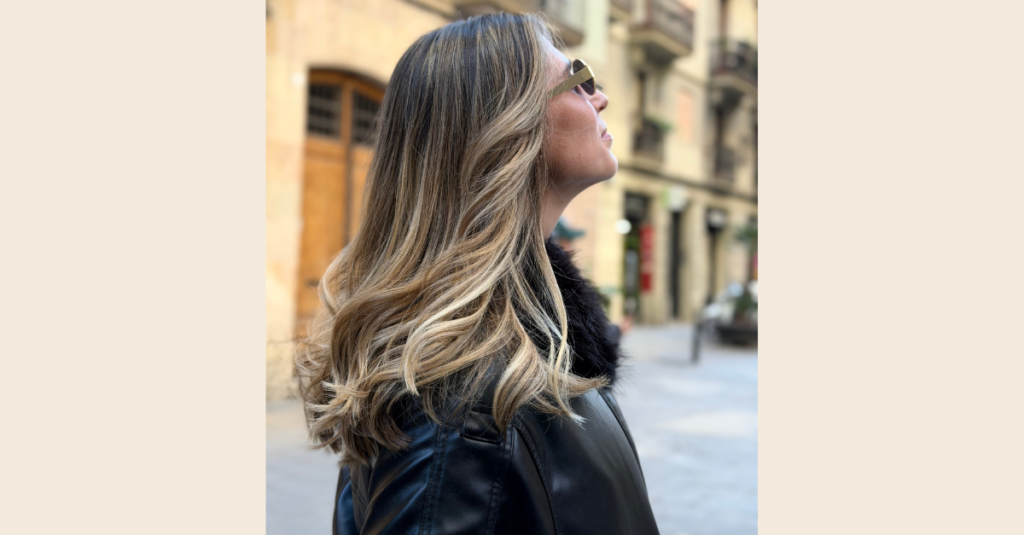
Balayage is meant to be low-maintenance. If yours fades within a few weeks, the technique is almost never the problem: what happens after you leave the chair usually is. At Noon, a balayage specialist salon in Barcelona’s El Born, we see it constantly: a beautiful result on the day that dulls down long before it should, simply because nobody explained the aftercare. With the right routine, a well-done balayage can stay bright and balanced for several months without a touch-up.
Why balayage fades faster than it should
When hair is lightened to create a blonde – sandy, beige, honey, or balayage highlights over a darker base – the hair fibre becomes more porous. Porosity doesn’t mean damage: it means the cuticle sits more open, so pigment escapes more easily if it isn’t sealed properly after the service.
What often “disappears” isn’t the base colour, it’s the toner sitting on top of it. That toner is what neutralises brassy yellow or orange tones and gives blonde its light. Without the right care at home, it fades within weeks.
At Noon, we work colour with precision from the first diagnosis. But the result doesn’t end when you leave the salon — it continues in your daily routine. That’s the part most hairdressers never really explain.
What happens to your hair after a balayage
Lightening opens up the hair’s internal structure to lift or deposit pigment. After the service, that fibre needs two things: a sealed cuticle to hold the tone, and sulfate-free products that won’t strip the toner with every wash.
If either of those is missing, or if hair goes into the service carrying build-up without a proper detox first, the result fades faster than it should. Not because of the technique used in the chair, but because of the condition the hair was in going in, or how it was cared for afterwards.
In Barcelona, where the water is moderately hard, mineral build-up in the fibre is one of the most common reasons colour dulls between visits. It’s a detail few clients know about, and it makes a real difference to how long a balayage lasts.
How to maintain your balayage at home
A sulfate-free shampoo made for lightened hair
The first mistake that shortens a balayage’s life is the shampoo. Strong sulfates clean too aggressively: they strip the toner, dry out the fibre, and speed up colour oxidation. For lightened hair, the shampoo needs to be sulfate-free, free of heavy silicones, and formulated specifically for blondes or treated hair.
At Noon we use and recommend I.C.O.N.’s Pure Light line, which cleans without damage and carries a violet pigment that neutralises yellow tones with every wash. Using it once or twice a week is enough to hold the tone between visits.
Conditioner: not an optional step
Conditioner’s job after a wash is to close the cuticle. If the cuticle stays open after shampoo, pigment escapes easily and hair loses brightness and colour ahead of schedule. It isn’t a luxury step, it’s the logical follow-through of washing lightened hair.
Weekly treatment: right frequency, right product
A mask or deep-hydration treatment once a week is enough for balayage in good condition. More often doesn’t improve the result, it can overload the fibre or throw off the tone’s balance if the product isn’t formulated for lightened hair.
I.C.O.N.’s Cure line, with gluten-free quinoa, tripeptides, and aloe leaf, seals and protects the cuticle while adding shine and manageability. It’s the weekly treatment we recommend at Noon to keep a balayage looking its best between salon visits.
How often you actually need to come back
One of balayage’s biggest advantages over other colouring techniques is that it doesn’t grow out with a visible line. That means no monthly touch-ups, and it’s exactly why so many clients choose it in the first place.
Toner and hydration in the chair: every six to eight weeks
Ideally, come back every six to eight weeks to refresh the toner and get a deep hydration treatment in the salon. This service is noticeably lighter than repeating a full balayage, and it’s what keeps the colour bright without overworking the fibre.
A full balayage: twice a year is enough
A well-designed balayage can be repeated twice a year. For clients with demanding schedules, that’s one of the most practical arguments for the service — not just an aesthetic one.
The most common mistakes that shorten a balayage’s life
At Noon, we’ve seen the same patterns for years in clients who come in with faded colour ahead of schedule. The most frequent:
Washing with water that’s too hot. Heat opens the cuticle and speeds up pigment loss. A cool-water rinse at the end of your wash is a small habit with a real effect on how long colour lasts.
Supermarket shampoos with sulfates. Not every shampoo labelled “for coloured hair” is formulated for lightened hair. The difference between a professional sulfate-free product and a mass-market one shows up in the tone within two weeks.
Skipping conditioner. It’s the most common mistake, and the one that fades a result the fastest.
Applying mask daily without a plan. More product doesn’t mean a better result. Over-conditioning can throw off the tone’s balance if the mask isn’t formulated for blondes.
Skipping a detox before the service. Hair carrying product build-up absorbs colour unevenly. A detox before balayage is the step that makes the biggest difference to how even and long-lasting the result is — and one most salons skip.
Balayage in Barcelona: honey tones vs. babylights
Yes, the aftercare is the same. Whether you’re after balayage honey tones or classic babylights, both involve lightening the fibre, and any lightened hair needs the same kind of care afterwards. The difference between the two is visual – how intense the light looks, how the highlights are placed, how natural the gradient reads – not the maintenance logic behind them.
If you’re comparing balayage hairdressers in Barcelona, one simple question tells you a lot: do they explain how to maintain the colour at home before you leave the chair? The technique is half the work. The other half happens in your bathroom every week.
FAQ
Does balayage damage your hair?
Done well, with the right timing and products, balayage shouldn’t compromise hair health. At Noon we run a diagnosis before the service to assess the fibre’s condition and confirm it can take lightening safely. If it needs prep work first, we explain that before starting.
How long should a well-maintained balayage last?
With the right at-home routine – sulfate-free shampoo, conditioner, a weekly treatment – plus a toner refresh every six to eight weeks, the result can stay bright and balanced for four to six months.
Do I need to come back every month?
No. That’s one of balayage’s real advantages over techniques that grow out with a visible line. A toner-and-hydration appointment every six weeks or so is enough to maintain the colour. A full balayage can be repeated twice a year.
Can I use any shampoo on coloured hair?
Not every one is right for lightened hair. Look for a shampoo that’s sulfate-free, free of heavy silicones, and made specifically for blondes or lightened hair. Generic “coloured hair” shampoos are usually formulated for darker colour and don’t respect a blonde’s tonal balance.
What’s the difference between balayage and traditional highlights?
Traditional highlights are applied with foil or a cap and grow out with a visible line, which means frequent touch-ups. Balayage is hand-painted, strand by strand, to create a gradient that grows out naturally without that line. The result reads more organic, and the maintenance is significantly lighter.
The diagnosis before your Barcelona balayage: why Noon always starts there
Before any colour service at Noon Salón, Iván — Noon’s technical director, who leads every balayage and colour service personally — assesses the real condition of the hair: its porosity, its service history, the health of the fibre, and what’s realistically achievable without compromising it. If getting the result you want takes two sessions to do properly, that’s explained before starting, not halfway through.
That diagnosis is what makes sure the balayage we design is right for your specific hair, not a generic technique applied without context.
If you’re looking for a balayage specialist in Barcelona where technique and aftercare go hand in hand, book your free diagnosis at Noon Salón, tell us what you have in mind, and we’ll walk you through what’s possible, how to look after it, and exactly how long it’ll take.