



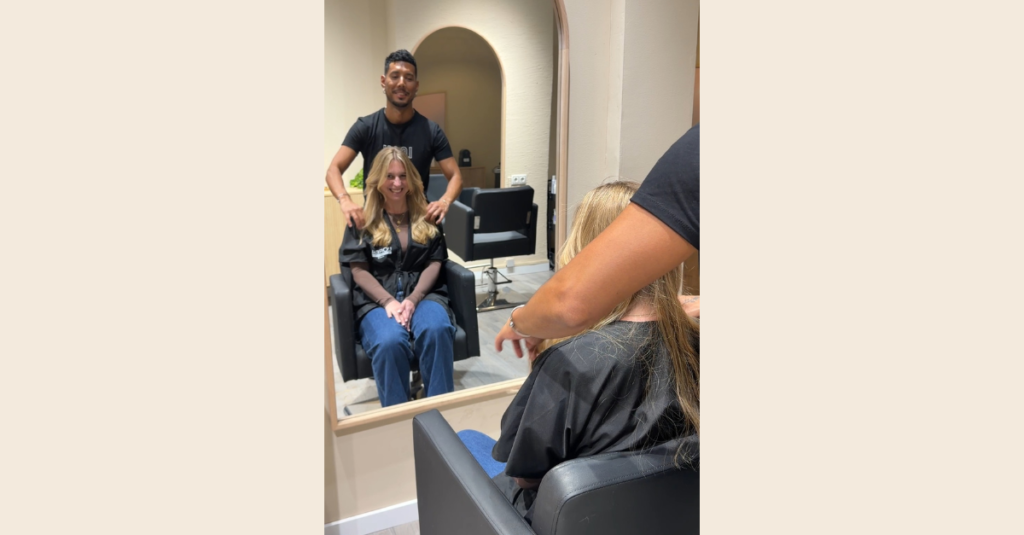
A professional hair diagnosis is what separates a predictable result from a guess. Before applying any colour or straightening technique, a professional hair colourist needs to assess the real condition of your hair, understand what you’re after, and confirm that what you’re asking for is actually achievable without compromising the fibre. Skip that step, and you’re working blind, and that never ends well.
At Noon Salón, every service starts with a diagnosis. It isn’t a five-minute formality: it’s the foundation everything else is built on. This article walks through exactly what we assess, what we’ll ask you, and how that process shapes the final result.
What a hair diagnosis is, and why it can’t be skipped
A hair diagnosis is the technical assessment a stylist carries out before starting any service, especially colour, highlights, or straightening. Its purpose is simple: understand the hair’s real starting point so the plan that follows actually works.
This isn’t about improvising and hoping something reasonable comes out. A proper diagnosis catches limitations before they become problems: hair carrying a lot of chemical history doesn’t respond the same way as virgin hair, and dehydrated fibre needs a completely different approach to healthy fibre.
The difference between a salon that diagnoses and one that doesn’t is the difference between working to a plan and working on luck. And in colour work, luck isn’t a strategy.
What gets checked during a hair diagnosis
When you sit down in a hair salon specializing in blonde, the first thing that should happen isn’t someone asking what colour you want. The first thing is understanding what hair you’re actually working with.
The fibre’s current quality and condition
The stylist checks texture, porosity, elasticity, and thickness. Porous hair, for example, doesn’t hold pigment as easily, which means a blonde applied over that base will fade faster if it isn’t treated first.
They’ll also look for damage built up from styling tools, previous lightening, or harsh products. All of that shapes the technical decisions that come next.
Chemical treatment history
This is where the questions get specific. Do you have a straightening treatment in your hair? What colour are you currently wearing? When was the last chemical process you had done? Every previous treatment leaves a mark on the fibre, and the stylist needs to know exactly what’s underneath before adding anything new.
Hair that’s already had a keratin infusion, for instance, responds very differently to lightening than hair with no chemical history at all. Ignoring that detail is the fastest route to an unpredictable result.
Your at-home care routine
It might sound like a minor question, but it isn’t. How you wash your hair, what products you use, and how often you reach for heat tools all shape how long a result actually lasts.
A technically flawless balayage can fade within weeks if the aftercare isn’t right. But if there’s no real intention to maintain it at home, the stylist needs to know that too, so the proposal can be adjusted to something realistic for your routine.

The questions you’ll be asked (and why each one matters)
In a salon that runs a real diagnosis, these are the standard questions before a colour, highlights, or organic straightening service:
When was your last salon visit? — This helps estimate how long the hair has gone without professional care, and what maintenance it’s had.
What colour are you currently wearing? — A permanent dye and a colour rinse leave very different residue in the fibre, and that shapes what can safely go on top.
Do you have any straightening or chemical treatment in your hair? — Some straightening treatments react badly with certain lighteners. Knowing beforehand avoids surprises.
What products do you use at home? — A shampoo with harsh sulfates strips pigment. If the stylist knows that, they can adjust the formula or recommend a care routine that protects the result.
Do you use straighteners, a blow-dryer, or curling tools often? — Heat build-up weakens the fibre. The stylist factors that in when deciding how far they can safely push the lightening or straightening.
None of these questions are small talk. Every answer builds the map the stylist needs to make sound technical decisions.
How your reference photo gets adapted to your actual hair
Plenty of clients arrive with a reference photo, and that’s a good thing. The problem starts when that photo gets treated as a fixed destination without accounting for the starting point.
A professional at a colorist salon treats that photo as inspiration, not a literal instruction. From there, they adapt the result to the hair’s real condition, your skin tone, and your lifestyle. Someone who spends their days at the beach needs a colour and cut that hold up to that life. Someone who works in an office with their hair tied back needs something else entirely.
And if there’s no reference at all, the stylist helps find the right direction. Always with the same principle: the result should suit the person wearing it, not the person in the photo.
That ability to adapt is exactly what separates a specialist from someone who simply copies. It’s why Noon works this way: organic hair straightening and balayage aren’t generic services, they’re techniques built around the individual.
What happens without a diagnosis
Without a diagnosis, there’s no order to the process. The stylist starts without knowing exactly where they’re headed, makes decisions on the fly, and the result depends more on chance than technique. Neither the professional nor the client can have clear expectations.
That doesn’t automatically mean the result will be bad. But it does mean it isn’t controlled. And in technical services where hair health is on the line – lightening for blonde, or a chemical straightening treatment – losing that control can mean real damage.
A diagnosis turns the process into something linear: starting point → plan → expected result. Without it, it’s a route with no map.
The diagnosis isn’t just for first-time clients
A common misconception is that diagnosis only applies the first time. In a professional salon, every visit starts with an assessment, even a brief one.
If you’re already a client, the questions shift: how did the last colour hold up? Did it fade sooner than expected? Is there anything you’d like to adjust? How has your hair responded since your last visit? That ongoing check-in lets the stylist fine-tune the technique visit by visit and improve the result each time.
It works the same way a doctor reviews your test results periodically, accumulated context makes for better decisions.
Diagnosis at Noon Salón
At Noon, diagnosis is part of every service: blonde, highlights, organic hair straightening, and haircuts too. There’s no charge and no obligation: if, after assessing the hair, we determine that what you’re after needs two sessions to do properly, we explain that before starting, not halfway through.
That level of technical honesty is what protects both the result and your hair’s long-term health. We’d rather tell you what you need to hear before starting than have you discover it partway through.
If you’re thinking about a colour change, a balayage, or organic straightening, the first step is a diagnosis. Book yours, free and with no obligation.
FAQ
Does a hair diagnosis cost anything?
No. At Noon Salón the diagnosis is free, with no obligation. It’s a technical assessment of your hair’s condition that we carry out before any service, to make sure you get the best possible result.
How long does a hair diagnosis take?
It depends on the service. For a haircut, it might be a five-minute conversation. For a technical service like balayage or organic straightening, the diagnosis goes deeper – checking the fibre’s condition, reviewing chemical history, and building a personalised proposal.
Do I need to bring a reference photo?
It isn’t required, but it helps. If you bring one, the stylist adapts it to your hair type, skin tone, and lifestyle. If you don’t have one, the team helps you find a direction that actually works for you.
What happens if the diagnosis says I can’t get what I asked for?
We’ll tell you clearly before starting. If a result needs several sessions to achieve safely, we propose a staged plan. We never push through a process that could compromise your hair’s health.
Is the diagnosis done at every visit, or just the first time?
Every visit at Noon starts with an assessment, even a brief one. With returning clients, we check how the colour or straightening has held up, whether anything needs adjusting, and how the hair is responding to at-home care.